Showing posts with label Nicaragua. Show all posts

La Carpio

In addition to classes at ICADS, we also had a few day long field trips during block I. For the first, we went to an organic coffee farm. The second, we visited an agroforestry system. The day trip that I will remember the most is the one we took to La Carpio, a marginlized community (more or less a ghetto) outside of San Jose with a large proportion of Nicaraguan immigrants. Nicaraguan immigrants are seen by some Costa Ricans in a negative light in the same way Mexicans are seen by some in the United States. They are often accused of bringing with them violence, gangs, and other social problems. In some immigrant communities, police will not even respond to calls, contributing to problems that are, for the most part, blown out of proportion by the media.
The road to La Carpio is a thin causeway, with cliffs on both sides from what appeared to be pit mines. This is a place where there are gravel streets and improvised homes built with whatever materials can be found. Right across the river is the site of San Jose's dump, the only location the government could find that wouldn't create public outcry.
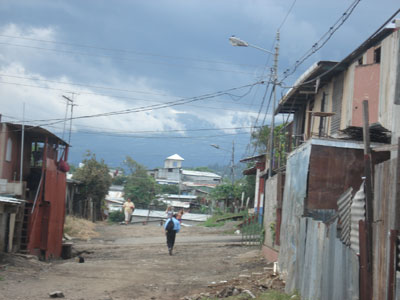
Photo of La Carpio found here.
Here, small groups of students were assigned to interview various people in the community about their experience as an immigrant. I can't forget the woman we talked to. Her tragic story exemplified the thesis (which we were examining) that immigration is motivated by a complicated mix of circumstances, with economic factors being only part of the equation.
This woman fled Nicaragua not only to escape poverty, but to escape horrible abuse inflicted upon her by her father. A drunk, he was physically abusive to both his wife and daughters. The woman showed us scars where he had burned her, and broke into tears as she told us that at times, the emotional pain had been so bad that she wanted to die. The situation was made worse by the fact that her mother refused to abandon him, supporting him financially and enabling his alcoholism. Eventually she fled, and left without the support of her family had to make it on her own. She told us how she and a friend had crossed the border through wilderness, running because they thought they were being chased by a tiger. She made her way to San Jose, where she was able to find work cleaning houses, get married and have children. She said she feels lucky now, to be alive and have a means to support her family. For a while she sent remittances to her mother and sisters, but stopped when she learned that the money was still going to her father. Although the physical and emotional scars remain, she is no longer suicidal, something she attributes to God.

Nicaragua

(2/14-2/20)
This picture was taken from the bus as we passed through the narrow strip of land between the Pacific and the lago de Nicaragua. The volcano is on an island in the middle of the lake.

Our first night (monday) we stayed in an inn in the capital city of Managua. The following day we took a tour of the city. We visited a group of former banana plantations workers who live in a shanty town in the park as a protest against the health problems they developed due to pesticide use. That afternoon, we drove to Matagalpa, a small city in the north. There we split up, some staying with host families in the city and others with families in San Ramon, a nearby town. I was in the latter group. While I liked San Ramon, I didn't have the best experience with my host family there. Others actually bonded with their families, but mine seemed disinterested in me and we didn't really talk.
On Tuesday we visited UCASAN, an agricultural/tourism project of a local indigenous community. Wednesday we had two lectures, one on the communal movement in Nicaragua and the other on the Nicaraguan perspective of migration to Costa Rica. Afterwards, most of the group went to the Castillo de Cacao, a museum/chocolate factory where they roast, grind by hand, and process chocolate from cacao. The resulting product is very dark and rich because they do not add milk.
Thursday morning we went to Chaguitillo, where we saw some petroglyphs and a museum of pre-columbian art. We also heard a talk about the community group that is supporting these sites. In the afternoon we traveled to Masaya Volcano, which had the most amazing scenery of any place on this trip.
We spent the last two nights in Granada, an old city with beautiful colonial architecture. Our hotel there, the Oasis, was really nice. It had a common area with hammocks, a garden/atrium, a pool, and a rooftop terrace. On Friday we visited La Casa de la Mujer, a government sponsored womens organization. We went through the central market, where I got a cheap hammock. That night we had a talk with some members of an opposition party about some of the problems with the current political scene. On Saturday we made our return trip to Costa Rica.
There is one aspect of our trip to Nicaragua that all who were there will not soon forget: the ordeal of crossing the border. For all intents and purposes, there is only one point to legally cross between these two countries. Due to the sheer volume of people, understaffing, and corrupt officials, it can take hours to get a simple stamp on your passport. The line curls backs and forth in front of, and then around, the immigration building. On our way in it didn't take too long, but to leave Nicaragua we had to wait about four hours in the hot sun.
This is the giant Nicaraguan flag in Managua